
"Nations need to recognise higher education as the engine of economic growth and prosperity," says Dr Susan Aldridge, president, University of Maryland University College, US, Aziz Haniffa reports
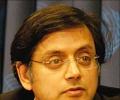
'We are very grateful that the US takes the trouble to keep us informed and to consult with us as this situation is being managed by them,' Minister of State for External Affairs Shashi Tharoor tells rediff.com's Aziz Haniffa.

When Prime Minister Manmohan Singh and US President Barack Obama sat down at the long table in Hyderabad House, the venue for the government's summit meetings, who were the ministers and officials present on both sides?
Hardeep Singh Puri, India's Permanent Representative to the United Nations and the architect of India's stunning diplomatic victory this week, speaks to Aziz Haniffa.
Veteran diplomat Howard B Schaffer pinpoints the reasons behind United States's reluctance to get involved in the Kashmir imbroglio, and the changing hues of the insurgency in the Valley.
Jonah Blank, former journalist and now policy director for South Asia on the powerful Senate Foreign Relations Committee, believes the Bush administration should have expended its political capital on strongly supporting India's bid for a permanent seat in the United Nations Security Council and being a catalyst in India securing this long-desired position in the world body, instead of the US-India civilian nuclear deal.
There's a strong sense inside the Democratic leadership that if you care about India, now is the time to stand up for it, says Graham Wisner, counsel at the top international lobbying firm Patton Boggs.
In an exclusive interview to Rediff.com, US Assistant Secretary of State Robert O Blake speaks about President Obama's trip to India, the recent US-India Strategic Dialogue and the fate of the nuclear liability bill.
The chairman of the powerful House Foreign Affairs Committee, US Congressman Howard Berman, has said that he is closely reviewing all American assistance being provided to Pakistan and that "to the extent we are going to provide security assistance, it should be focused on counter-terrorism, not rekindling an arms race in South Asia."
Sri Lanka's new Foreign Minister Gamini Lakshman Peiris, who visited Washington, DC last month, feels the tensions that existed in the United States and Sri Lanka during the height of the conflict with the Liberation Tigers of Tamil Eelam, when Colombo refused to acquiesce to a ceasefire, have been repaired.
'In today's economically integrated world, economic relationships constitute the bedrock on which social, cultural and political relationships are built,' the minister tells the US-India Business Council in Washington, DC.
'He views a partnership with India as one of the building blocks of our relationships in the 21st century,' says Randy Scheunemann, director of foreign policy for the John McCain campaign.
At a seminar in Washington, DC, a group of former diplomats, military leaders, politicians, businessmen and others said the minimum requirement from Pakistan is 'an irrevocable disbandment of the infrastructure of terrorism.'
Samajwadi Party general secretary Amar Singh, who was instrumental in his party's volte-face on supporting the United Progressive Alliance government and the India-United States nuclear deal, recently visited the United States to meet with the presidential hopeful Hillary Clinton who he says is a good friend. In this interview, he speaks about the nuclear deal and the post-poll scenario
"India would have loved to get more involved in Sri Lanka positively -- helping us to fight terrorism. Now, remember, India suffered a lot in the sense, it lost its leader -- Rajiv Gandhi was assassinated by the LTTE. That is something, which India can never forgive nor forget," says Razik Zarook, Sri Lankan President Mahinda Rajapakse's Counsel.
The US's first lady ambassador to India wants to set a new tone for the India-US relationship. Aziz Haniffa reports from Washington, DC.

Terry McAuliffe, chairman of Hillary Clinton's presidential campaign, speaks exclusively to Aziz Haniffa.

Aziz Haniffa spoke to Dr Pat Basu soon after he was chosen as a White House Fellow. The interview.
The least Pakistan can do, External Affairs Minister S M Krishna tells Aziz Haniffa, is to bring the culprits who orchestrated the terror attack on Mumbai to justice.
'In the struggle India is going through, the US must be seen very clearly as being in India's corner. Pakistani-based terrorism is not a problem that India faces alone. It's part of a common problem that the US faces as well,' says India expert Ashley Tellis.

India is one of the most important partnerships the US has, says the man tipped to be the Democrat presidential candidate.
Aziz Haniffa meets Maharaj Kaul, a man fighting for the cause of Kashmiri Pandits -- those who were displaced and those who are stuck in Jammu
'There has been an almost palpable change in the black community. There is a energy in the air that wasn't there before; there's a spark and a light now that was previously missing. I look around and I see a change in the way we carry ourselves, the way we speak to each other and treat each other,' says Jann Marie Hodge, one of the thousands of African Americans who have arrived to witness the Barack Obama's historical swearing-in as America's first black president.


'The support Pakistan has given to terrorist actions in Kashmir -- official or unofficial -- must cease.' John \n\nKerry, in an exclusive interview to rediff.com
'I will make sure criticism of business practices which harm American workers doesn't generate a backlash against Indian Americans, the same way trade disputes with Japan in the 1980s led to incidents of anti-Asian bigotry,' says John Kerry.
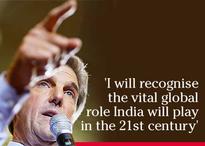
'I will work closely with New Delhi to strengthen a relationship built on shared values and interests.' John Kerry, in an exclusive interview with rediff.com
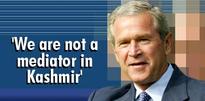
'Our relationship with India exists on its own merits, and is independent of our relationship with Pakistan,' President Bush tells rediff.com in his first interview to any South Asian media outlet.

Veteran diplomat Howard B Schaffer says if Delhi continues to be in denial, and Islamabad is tempted to stoke the fires as it always has, the Kashmir situation could unravel fast.

'He has a vision of India like his dad. You can see in Rahul's eyes -- at least I see -- his father's unfinished agenda,' says Sam Pitroda who has known the Congress leader since he was a child.
An interview by Indian Ambassador to the US Ronen Sen to rediff.com Managing Editor Aziz Haniffa in Washington on the Indo-US nuclear deal created an uproar in Parliament.
Former president Dr A P J Abdul Kalam, visiting Washington, DC, did what he does best and likes the most in recent years -- talking to and engaging with students. But, Kalam was also not averse to conveying the message to the powers that be in the US that their reluctance to utilize the core competence of India in science and technology was to their detriment and cited the example of the joint ventures between Indian and Russian scientists.
Daryl Kimball, executive director of the Washington, DC-based Arms Control Association believes India's expectation of a 'clean exemption' at the Nuclear Suppliers Group meeting scheduled for August 21 is "a fantasy".
'I've been a member of the family really. But I certainly am critical of a number of the ways that, in particular the President, has run his country.'

'Global trade is vital to the success of our economy and job creation. We need to continue to expand trade and work to open markets for American goods and services,' President Bush tells Aziz Haniffa in the final part of an exclusive interview.
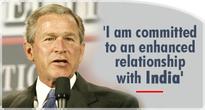
In an exclusive interview with rediff.com -- his first with any South Asian media organisation -- President Bush \n\nlauded India for being "an outstanding partner in the global war on terror."
'The trajectory of the US-India relationship is very different from that of the US-Pakistan relationship and those trajectories neither meet nor criss-cross each other,' says Foreign Secretary Kanwal Sibal.
